
"Explore museums from around the world, discover and view hundreds of artworks at incredible zoom levels, and even create and share your own collection of masterpieces. ... Simply select a museum from the homepage and then either chose ‘Explore the museum’ or ‘View Artwork’. Once you are in the main site use the drop-down menus or the side info bar to navigate between artworks and museums. Finally create and share your own collections online." (quoted from their website)
The images used to introduce galleries participating Google Art Project are stunning.
Links for Facebook viewers: my art collage in Vuvox; video about the project)
P.S. I'd forgotten how quick it is to build a collage in Vuvox if you don't get fancy -- but the creative possibilities are a lot of fun.
Friday, February 4, 2011

Tuesday, February 1, 2011
Great Tool offered free for the next 24 hours on GIveaway of the Day -- iSpring Presenter
Giveaway of the Day is a website that offers one free tool each 24 hour period. If you choose to download, you must install and activate the Giveaway license inside that 24 hour period before the deal expires. Usually this means you'll have a forever license for the product. Scrolling down the page takes you to the comments of those who've tried the product that day. They're a good guide about whether the program does what it says, if there are other free alternatives, and if there are any downloading issues. When you unzip the downloaded file, open the "Read Me" instructions first and follow them exactly. That will ensure you don't end up with a trial version, but get all the information needed to register your copy correctly.
Today's Giveaway is iSpring Presenter which is a great tool if you use PowerPoint. From the website: " iSpring Presenter works as a PowerPoint AddIn. It transforms your PowerPoint into a high end tool for creating engaging and interactive Flash based e-learning courses that can be viewed on virtually any computer or platform." It comes bundled with iSpring quizmaker. [Note: it does not work with the Open Office alternative to PowerPoint.] Here are links to a sample video and their tutorials.
Turning PPT into flash with all the animations preserved is a great way to display student's work without going to something like Animoto. You can publish it to Slideboom (keeping the account private if you wish) and pull in the embed code from there needed for students to display their work in their blogs or on a class website or wiki. The Slideboom Shop which has PPT templates is offering an 80% discount until Feb.3. They're still on the pricey side, but the graphs and charts might be good if students are integrating math or statistics into projects. There's also a free set and a weekly sample you can download free.
Finally, if you're into travel, KLM has a contest called "Pack Up Your Pals" where you can win a free trip by getting friends to validate your invitation. If you have long lists of Facebook or other friends, you can get multiple contest entries.
Today's Giveaway is iSpring Presenter which is a great tool if you use PowerPoint. From the website: " iSpring Presenter works as a PowerPoint AddIn. It transforms your PowerPoint into a high end tool for creating engaging and interactive Flash based e-learning courses that can be viewed on virtually any computer or platform." It comes bundled with iSpring quizmaker. [Note: it does not work with the Open Office alternative to PowerPoint.] Here are links to a sample video and their tutorials.
Turning PPT into flash with all the animations preserved is a great way to display student's work without going to something like Animoto. You can publish it to Slideboom (keeping the account private if you wish) and pull in the embed code from there needed for students to display their work in their blogs or on a class website or wiki. The Slideboom Shop which has PPT templates is offering an 80% discount until Feb.3. They're still on the pricey side, but the graphs and charts might be good if students are integrating math or statistics into projects. There's also a free set and a weekly sample you can download free.
Finally, if you're into travel, KLM has a contest called "Pack Up Your Pals" where you can win a free trip by getting friends to validate your invitation. If you have long lists of Facebook or other friends, you can get multiple contest entries.
Monday, January 17, 2011
A Cool Tool -- Cohere
This one comes under the heading of 'sensemaking'. (Image link for Facebook view.)
 Cohere is a visual idea mapping for "trying to construct coherent patterns from the ocean of information" available online. It goes way beyond familiar social bookmarking tools and tag clouds and makes possible the development of idea clouds which can have one or more websites associated with each individual idea.You can also install a Firefox plugin so you can add to your web of ideas as you browse.
Cohere allows you to weave relationships among the tags and phrases. As you build the connections a large web grows that can be viewed as dynamic a big picture. As the web grows, you can focus in on just one 'corner' or hub and filter the kinds of related ideas you want to see. The ideas can be viewed as a list, a timeline, or by geographic location on a Google map. Click the 'Connections' view to see the dynamic web.
This seems to be a sister project of the downloadable dialogue mapping tool -- Compendium.
I haven't tried it yet, but I've been thinking about how this could surpass Twitter as a conference backchannel tool because the ideas are archived and connected. I'm going to work on my own math wiki page and see if I can create a new web of ideas and websites for my next presentation. I'll post it here when I've finished. In the meantime, here's the link to the video introduction (link for Facebook view).
Here's a sample about what climate sceptics believe based on this BBC article by Richard Black (2007). It may load a little slowly, but it's worth a look.
 Cohere is a visual idea mapping for "trying to construct coherent patterns from the ocean of information" available online. It goes way beyond familiar social bookmarking tools and tag clouds and makes possible the development of idea clouds which can have one or more websites associated with each individual idea.You can also install a Firefox plugin so you can add to your web of ideas as you browse.
Cohere allows you to weave relationships among the tags and phrases. As you build the connections a large web grows that can be viewed as dynamic a big picture. As the web grows, you can focus in on just one 'corner' or hub and filter the kinds of related ideas you want to see. The ideas can be viewed as a list, a timeline, or by geographic location on a Google map. Click the 'Connections' view to see the dynamic web.
This seems to be a sister project of the downloadable dialogue mapping tool -- Compendium.
I haven't tried it yet, but I've been thinking about how this could surpass Twitter as a conference backchannel tool because the ideas are archived and connected. I'm going to work on my own math wiki page and see if I can create a new web of ideas and websites for my next presentation. I'll post it here when I've finished. In the meantime, here's the link to the video introduction (link for Facebook view).
Here's a sample about what climate sceptics believe based on this BBC article by Richard Black (2007). It may load a little slowly, but it's worth a look.
Wednesday, January 12, 2011
Life after EDIM
On the weekend I received an email from Karena asking me to reach out to a prospective student who wanted some information about the EDIM program. I fired off an email asking what he'd like to know and he sent back some questions -- how I'd rate my experience and the rigor of the program and whether I found my learning useful. The most interesting one for me, however, was: "Is there life after the program?" This is a double whammy because I've also taken early retirement, so I didn't just go back to my old school life after I finished the EDIM program. I'm really trying to catapult myself into a life that still involves teaching but not the day-to-day responsibility of secondary classroom work. I thought my shiny new M.Sc. would give me access to lots of university level jobs, but alas, you now need a Ph.D or Ed.D to do a lot of that work and I'm not sure at 59 whether I'm up for 3-5 years more training and research before those doors open. So for now I peruse the online data bases of post secondary jobs weekly looking for interesting opportunities that don't have as a minimum requirement the completion of a doctorate.
Part of this process has required the polishing of my CV -- and I've had to ask myself repeatedly what I really have to offer and how can I wrap up a career of over 35 years into a few pages that will convince the screening committee that I can do the job. It's an interesting process -- rather like backwards building (yes -- Wiggins and McTigue are my new heroes!) a unit or a lesson. I have to start with the end in mind and try to sandwich the direct explanation of my skills and experience between layers of material that will connect to the recruiters in an interesting way.
Another thing I've discovered on this journey is that while many K-12 schools are bogged down by the effort to standardize learning so that all students exit with the same skills and knowledge sets, at the university level institutions and departments are coming together to map out the real learning outcomes for students and then to find the intersection between teaching content and reaching learners. I wonder how students who are now growing up in schools where the emphasis is on ticking off the standards as they progress through the grade levels will manage when they get to post-secondary training where they are expected to become partners in the management of their learning and must shoulder a large part of the responsibility of ensuring that they meet the outcomes.
The video that follows is from Royal Roads University in Victoria, BC. It's long but if you listen behind the details of the discussion to the intention of why this new work of curriculum mapping is being done, it makes for an interesting listen. Perhaps the most interesting questions are: "What questions you will ask to determine whether the program outcomes were met?" and "How can we know that the actions we're taking are making a difference?" But in the 21st century, these questions I think should be asked not only by us educators, but also the students. Wolf puts forward idea that we need to make space in the curriculum for the students to reflect on all they've learned -- to look back in order to move forward. If the students of today become the education critics of tomorrow, it may behoove us to grow learners who take away from their years in K-12 not only skills and knowledge but also an overarching appreciation for how much they have learned and how earlier learning was always the platform for new learning.
Part of this process has required the polishing of my CV -- and I've had to ask myself repeatedly what I really have to offer and how can I wrap up a career of over 35 years into a few pages that will convince the screening committee that I can do the job. It's an interesting process -- rather like backwards building (yes -- Wiggins and McTigue are my new heroes!) a unit or a lesson. I have to start with the end in mind and try to sandwich the direct explanation of my skills and experience between layers of material that will connect to the recruiters in an interesting way.
Another thing I've discovered on this journey is that while many K-12 schools are bogged down by the effort to standardize learning so that all students exit with the same skills and knowledge sets, at the university level institutions and departments are coming together to map out the real learning outcomes for students and then to find the intersection between teaching content and reaching learners. I wonder how students who are now growing up in schools where the emphasis is on ticking off the standards as they progress through the grade levels will manage when they get to post-secondary training where they are expected to become partners in the management of their learning and must shoulder a large part of the responsibility of ensuring that they meet the outcomes.
The video that follows is from Royal Roads University in Victoria, BC. It's long but if you listen behind the details of the discussion to the intention of why this new work of curriculum mapping is being done, it makes for an interesting listen. Perhaps the most interesting questions are: "What questions you will ask to determine whether the program outcomes were met?" and "How can we know that the actions we're taking are making a difference?" But in the 21st century, these questions I think should be asked not only by us educators, but also the students. Wolf puts forward idea that we need to make space in the curriculum for the students to reflect on all they've learned -- to look back in order to move forward. If the students of today become the education critics of tomorrow, it may behoove us to grow learners who take away from their years in K-12 not only skills and knowledge but also an overarching appreciation for how much they have learned and how earlier learning was always the platform for new learning.
Watch live streaming video from royalroads at livestream.com
Wednesday, January 5, 2011
The nature of insightful moments in learning
A study published in the May 13, 2010, issue of the online journal, Neuron, indicates that new learning does not always occur incrementally in the brain. When it comes to abandoning a previously learned behaviour pattern in order to master a new one, those 'aha! moments' we experience when we finally 'get it' are associated with new neuronal firing patterns that occur suddenly and often after several fully successful trials.
Researchers Daniel Durstewitz, Nicole M. Vittoz, Stan B. Floresco, Jeremy K. Seamans (the latter from my old alma mater, the University of British Columbia) discovered that
I think back to many of my former 'remedial' math students who still had not mastered such skills as fractions by the age 15 or more. In adolescents and adult learners the neural networks which encode the unsuccessful procedure have been strengthened during many hours of incorrect rehearsal over several years. These students also have to deal with a high level of emotional distress which we know blocks learning. In addition, " the same ensemble of prefrontal cortex neurons encodes two different rules through unique activity states or patterns" (Ashaman) which means the old learning and the new use the same neural real estate.
Unlearning and relearning requires that students be willing to attempt enough trials to 'get' the new process without even really registering any discernable brain activity which could reinforce their willingness to proceed. The light of the new learning doesn't turn up gradually like a rheostat. The switch is just off until it's flipped on. The realization that they've finally 'got it' and the encoding in the brain occur at the same time. They aren't going to feel like they are learning until they've let go of the old procedure and wholly accepted the new one.
What then can teachers do to help such students replace ineffective math learning with reliable methods? I think helping them understand just why they are finding the task so difficult can help. We should also clue in their parents and enlist their support when the going gets tough. We have to refrain from making promises we can't keep because they will be depending on their trust relationship with us to get them through moments of great self-doubt. If we say they are going to master an old skill, we have to to ensure that actually occurs. Finally we have to understand that presenting new information in an old way is not going to make the learning process or emotional self-governance easier. Giving students a new vivid learning experience to compete with the old pathway will mean they'll have distinct alternatives in their minds when confronted with new problems. I think as well, periodic review accompanied with a verbal rehearsal of the new process and discussion of how it differs from the old one can strengthen the new pattern and reinforce just how far the students have come from 'the old days'.
It's a big job to light up someone's entire prefrontal cerebral cortex in a new way. Success for the learner means making a global change in knowledge, emotional response, and self-image as a learner of math. The students and their teacher must share the belief that past failure need not predict future success, and the math classroom has to become a possibility space for all learners.
--------
References:
Ashman, Melissa (May, 2010). Brains Research Centre: Uncovering the science behind the "a-ha" moment. In Vancouver Coastal Health Research Institute News & Information.
Ehrenberg, Rachel (June, 2010). Eureka, brain makes real mental leaps. In Science News.
(May, 2010) Eureka! Natural Evidence for Sudden Insight. In Science Daily.
Researchers Daniel Durstewitz, Nicole M. Vittoz, Stan B. Floresco, Jeremy K. Seamans (the latter from my old alma mater, the University of British Columbia) discovered that
"when rats were required to deduce a new rule through trial and error, the entire prefrontal cortex neural network [emphasis mine] would abruptly shift to a new pattern of activity, rather than gradually as one might expect. Further, they found the shift in neural activity occurred one or two trials after the rats exhibited the correct behaviour for the task." (Ashman)It turns out that when we have to abandon old, less advanageous, rules and develop new strategies to cope with changing situations, the change in neural activity is not gradual and incremental and does not occur in isolated regions of the brain. Collecting new evidence through trial and error and formulating a better procedure requires that "virtually all the cells in the prefrontal cortex contribute to encoding all the elements in each task." The entire network then puts "together arbitrary types of information in novel ways" (Floresco quoted in Ashman).
"The rats tried different things, then hit on the correct strategy, realized it was correct, and then encoded the new rule all at once within the prefrontal cortex" (Seamans quoted in Ashman).Interestingly, the prefrontal cortex not only governs problem-solving and complex thought, but it's also in charge of emotion. It plays an important role in executive functions such as mediating conflicting thoughts, making choices between right and wrong or good and bad, predicting future events, and governing social control through the suppression of emotions. To my way of thinking this may explain why unlearning an old ineffective process and adopting a new one -- even with the promise that it will be more successful -- can be such a difficult process. It requires a huge amount of brain power plus a willingness to suspend disbelief in one's ability to conquer learning monsters and old beahviours long enough to change not only one's procedural understanding but all the emotional baggage that goes along with previous failure or ways of handling problems.
I think back to many of my former 'remedial' math students who still had not mastered such skills as fractions by the age 15 or more. In adolescents and adult learners the neural networks which encode the unsuccessful procedure have been strengthened during many hours of incorrect rehearsal over several years. These students also have to deal with a high level of emotional distress which we know blocks learning. In addition, " the same ensemble of prefrontal cortex neurons encodes two different rules through unique activity states or patterns" (Ashaman) which means the old learning and the new use the same neural real estate.
Unlearning and relearning requires that students be willing to attempt enough trials to 'get' the new process without even really registering any discernable brain activity which could reinforce their willingness to proceed. The light of the new learning doesn't turn up gradually like a rheostat. The switch is just off until it's flipped on. The realization that they've finally 'got it' and the encoding in the brain occur at the same time. They aren't going to feel like they are learning until they've let go of the old procedure and wholly accepted the new one.
What then can teachers do to help such students replace ineffective math learning with reliable methods? I think helping them understand just why they are finding the task so difficult can help. We should also clue in their parents and enlist their support when the going gets tough. We have to refrain from making promises we can't keep because they will be depending on their trust relationship with us to get them through moments of great self-doubt. If we say they are going to master an old skill, we have to to ensure that actually occurs. Finally we have to understand that presenting new information in an old way is not going to make the learning process or emotional self-governance easier. Giving students a new vivid learning experience to compete with the old pathway will mean they'll have distinct alternatives in their minds when confronted with new problems. I think as well, periodic review accompanied with a verbal rehearsal of the new process and discussion of how it differs from the old one can strengthen the new pattern and reinforce just how far the students have come from 'the old days'.
It's a big job to light up someone's entire prefrontal cerebral cortex in a new way. Success for the learner means making a global change in knowledge, emotional response, and self-image as a learner of math. The students and their teacher must share the belief that past failure need not predict future success, and the math classroom has to become a possibility space for all learners.
--------
References:
Ashman, Melissa (May, 2010). Brains Research Centre: Uncovering the science behind the "a-ha" moment. In Vancouver Coastal Health Research Institute News & Information.
Ehrenberg, Rachel (June, 2010). Eureka, brain makes real mental leaps. In Science News.
(May, 2010) Eureka! Natural Evidence for Sudden Insight. In Science Daily.
Sunday, November 7, 2010
Ways to use Twitter in class
Here's a repost from an Ontario teacher using Twitter in class. I'd probably try Twiducate instead. Students don't need to register, and you won't be shut out when Twitter is shut off because of overuse. His ideas are aimed for a grade 8 class. (Click the image.)

Tuesday, November 2, 2010
Containers or connections
This comes under the category of wow!!!!
 Click the image to see the full sized version. It has been reprinted from Judy Breck's Golden Swamp blog.
Meanwhile you can take this brain age calculation test. I didn't come off too badly, but then I wonder if there are actually different scores or if they give the same final result to everyone to give oldies like me a little boost.
And then give this test a try to see if you are more left or right brain dominant.
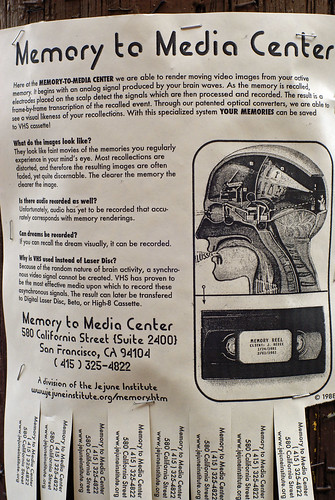
This final addition to today's meanderings may be of interest to people in the digital story telling couse. It seems we no longer need to interview and question to connect with family history. This company claims it can turn brain waves directly into videos.
 Click the image to see the full sized version. It has been reprinted from Judy Breck's Golden Swamp blog.
She has another blog called Learning Nodes which is dedicated to open learning. Her stuff is worth a look if you're in favour of connecting students to the global knowledge commons. She sees sees the way the brain is structured and functions as a metaphor for the interconnectedness (what she calls "intertwingularity") of the internet and the people who use it."On the left above is a screen shot of Science Standards from the Illinois State Board of Education (you can download the pdf from this page). On the right above is a drawing of a Synapse phosphoproteome network from the Genes to Cognition team at the Sanger Institute. The full size version of the image above is here.
I put the Illinois Learning Standards and the Synapse side-by-side to suggest that we require students to learn subjects inside of little boxes, while students think about them in highly connected networks. The boxes in the Standards are separated from each other in all sorts of ways: living things are in different boxes than processes of the Earth. Different things about the same subject are spread out over five different grade levels. There seems little chance of having a thought that relates an early box in “A” to a late box in “E.”
Yet the news for the future is very, very good! The beautiful Sanger Institute drawing of the synapse network looks an awfully lot like what subject knowledge does when we put in on to the open Internet. Students’ synapses would seem naturally to mesh with online learning because both are networks. Learners can – as the drawing suggests – start at most any point or level in a subject and follow what they are thinking and learning to connect it to any and all other points."
Meanwhile you can take this brain age calculation test. I didn't come off too badly, but then I wonder if there are actually different scores or if they give the same final result to everyone to give oldies like me a little boost.
And then give this test a try to see if you are more left or right brain dominant.
This final addition to today's meanderings may be of interest to people in the digital story telling couse. It seems we no longer need to interview and question to connect with family history. This company claims it can turn brain waves directly into videos.
Subscribe to:
Comments (Atom)


 Wilkes University
 Posts
Posts


