Wednesday, January 5, 2011

The nature of insightful moments in learning

A study published in the May 13, 2010, issue of the online journal, Neuron, indicates that new learning does not always occur incrementally in the brain. When it comes to abandoning a previously learned behaviour pattern in order to master a new one, those 'aha! moments' we experience when we finally 'get it' are associated with new neuronal firing patterns that occur suddenly and often after several fully successful trials.

Researchers Daniel Durstewitz, Nicole M. Vittoz, Stan B. Floresco, Jeremy K. Seamans (the latter from my old alma mater, the University of British Columbia) discovered that
"when rats were required to deduce a new rule through trial and error, the entire prefrontal cortex neural network [emphasis mine] would abruptly shift to a new pattern of activity, rather than gradually as one might expect. Further, they found the shift in neural activity occurred one or two trials after the rats exhibited the correct behaviour for the task." (Ashman)
It turns out that when we have to abandon old, less advanageous, rules and develop new strategies to cope with changing situations, the change in neural activity is not gradual and incremental and does not occur in isolated regions of the brain. Collecting new evidence through trial and error and formulating a better procedure requires that "virtually all the cells in the prefrontal cortex contribute to encoding all the elements in each task." The entire network then puts "together arbitrary types of information in novel ways" (Floresco quoted in Ashman).
"The rats tried different things, then hit on the correct strategy, realized it was correct, and then encoded the new rule all at once within the prefrontal cortex" (Seamans quoted in Ashman).
Interestingly, the prefrontal cortex not only governs problem-solving and complex thought, but it's also in charge of emotion. It plays an important role in executive functions such as mediating conflicting thoughts, making choices between right and wrong or good and bad, predicting future events, and governing social control through the suppression of emotions. To my way of thinking this may explain why unlearning an old ineffective process and adopting a new one -- even with the promise that it will be more successful -- can be such a difficult process. It requires a huge amount of brain power plus a willingness to suspend disbelief in one's ability to conquer learning monsters and old beahviours long enough to change not only one's procedural understanding but all the emotional baggage that goes along with previous failure or ways of handling problems.

I think back to many of my former 'remedial' math students who still had not mastered such skills as fractions by the age 15 or more. In adolescents and adult learners the neural networks which encode the unsuccessful procedure have been strengthened during many hours of incorrect rehearsal over several years. These students also have to deal with a high level of emotional distress which we know blocks learning. In addition, " the same ensemble of prefrontal cortex neurons encodes two different rules through unique activity states or patterns" (Ashaman) which means the old learning and the new use the same neural real estate.

Unlearning and relearning requires that students be willing to attempt enough trials to 'get' the new process without even really registering any discernable brain activity which could reinforce their willingness to proceed. The light of the new learning doesn't turn up gradually like a rheostat. The switch is just off until it's flipped on. The realization that they've finally 'got it' and the encoding in the brain occur at the same time. They aren't going to feel like they are learning until they've let go of the old procedure and wholly accepted the new one.

What then can teachers do to help such students replace ineffective math learning with reliable methods? I think helping them understand just why they are finding the task so difficult can help. We should also clue in their parents and enlist their support when the going gets tough. We have to refrain from making promises we can't keep because they will be depending on their trust relationship with us to get them through moments of great self-doubt. If we say they are going to master an old skill, we have to to ensure that actually occurs. Finally we have to understand that presenting new information in an old way is not going to make the learning process or emotional self-governance easier. Giving students a new vivid learning experience to compete with the old pathway will mean they'll have distinct alternatives in their minds when confronted with new problems. I think as well, periodic review accompanied with a verbal rehearsal of the new process and discussion of how it differs from the old one can strengthen the new pattern and reinforce just how far the students have come from 'the old days'.

It's a big job to light up someone's entire prefrontal cerebral cortex in a new way. Success for the learner means making a global change in knowledge, emotional response, and self-image as a learner of math. The students and their teacher must share the belief that past failure need not predict future success, and the math classroom has to become a possibility space for all learners.
--------
References:

Ashman, Melissa (May, 2010). Brains Research Centre: Uncovering the science behind the "a-ha" moment. In Vancouver Coastal Health Research Institute News & Information.

Ehrenberg, Rachel (June, 2010). Eureka, brain makes real mental leaps. In Science News.

(May, 2010) Eureka! Natural Evidence for Sudden Insight. In Science Daily.

Sunday, November 7, 2010

Ways to use Twitter in class

Here's a repost from an Ontario teacher using Twitter in class. I'd probably try Twiducate instead. Students don't need to register, and you won't be shut out when Twitter is shut off because of overuse. His ideas are aimed for a grade 8 class. (Click the image.)

Tuesday, November 2, 2010

Containers or connections

This comes under the category of wow!!!!

Click the image to see the full sized version. It has been reprinted from Judy Breck's Golden Swamp blog.

"On the left above is a screen shot of Science Standards from the Illinois State Board of Education (you can download the pdf from this page). On the right above is a drawing of a Synapse phosphoproteome network from the Genes to Cognition team at the Sanger Institute. The full size version of the image above is here.

I put the Illinois Learning Standards and the Synapse side-by-side to suggest that we require students to learn subjects inside of little boxes, while students think about them in highly connected networks. The boxes in the Standards are separated from each other in all sorts of ways: living things are in different boxes than processes of the Earth. Different things about the same subject are spread out over five different grade levels. There seems little chance of having a thought that relates an early box in “A” to a late box in “E.”

Yet the news for the future is very, very good! The beautiful Sanger Institute drawing of the synapse network looks an awfully lot like what subject knowledge does when we put in on to the open Internet. Students’ synapses would seem naturally to mesh with online learning because both are networks. Learners can – as the drawing suggests – start at most any point or level in a subject and follow what they are thinking and learning to connect it to any and all other points."

She has another blog called Learning Nodes which is dedicated to open learning. Her stuff is worth a look if you're in favour of connecting students to the global knowledge commons. She sees sees the way the brain is structured and functions as a metaphor for the interconnectedness (what she calls "intertwingularity") of the internet and the people who use it.

Meanwhile you can take this brain age calculation test. I didn't come off too badly, but then I wonder if there are actually different scores or if they give the same final result to everyone to give oldies like me a little boost.


And then give this test a try to see if you are more left or right brain dominant.

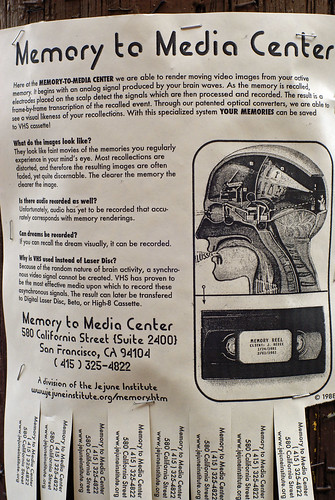
This final addition to today's meanderings may be of interest to people in the digital story telling couse. It seems we no longer need to interview and question to connect with family history. This company claims it can turn brain waves directly into videos.

assuming one remembers

Wednesday, October 27, 2010

Philippe Cousteau webinar, Thursday Oct.28

In case you haven't been reading the News section of your course moodle, Karena has arranged a Wilkes webinar with Philppe Cousteau for tomorrow at 4:00 p.m. EDT. EDIM alum & friends are also welcome to attend. The session will be archived and all those who register will receive the link.

Topic: Spotlight on the Gulf Spill, How it Affects Us Now and in the Future. Questions, Answers and More Uncertainty

Date:
Thursday, October 28
Time: 4:00 p.m. (EDT)

Registration: http://community.wilkes.edu/gradwebinar

*Pennsylvania educators will receive one hour of Act 48 credit if they provide their PPID at the time of registration

About this webinar: Join Philippe Cousteau, grandson of the legendary Jacques Cousteau and Discovery Education Chief Spokesperson for Environmental Education, as he takes you to the Gulf through pictures and stories from his recent trip to evaluate the effects of the Gulf Oil Spill. He will discuss the effects on regional wildlife and ecosystems as well as focus on how the oil spill will affect us now and into the future.

If you have any questions about this event, you can contact me at karena.zdeb@wilkes.edu or 800-945-5378 x7841

Hope you will join us!

For those who no longer can access the EDIM moodle, try this link and login with your name and a current email address: https://discoveryedevents.webex.com/discoveryedevents/onstage/g.php?t=a&d=666687010.

Take-away for today:

Here's a lesson plan I did for the Globalization and Advocacy course which you are welcome to download. I used the Inquiry-Based Learning 5E's template furnished by Matt Cwalina and built a math lesson around the theme "Oil and Water Don't Mix" --

http://www.scribd.com/full/39526856?access_key=key-1ecvemo21p3cxopf37u1

Enjoy!

Thursday, October 21, 2010

Attention Glogster Lovers ...

This notice recently landed in my inbox ---

The student accounts are great because they don't require any personal information from the kids. You activate them from your dashboard. If you have not done this On the right side across from the messages, there will be a notice that says you have no student accounts. When prompted about how many you want, choose the maximum (100 until Nov. 7). I have no idea whether the new 50 rule will apply to old accounts that have not taken advantage of this feature or just the new ones, so I did mine today just in case. Now I just have to edit them to have individual icons and user names that make sense!

Sunday, October 17, 2010

I shake therefore I am: The Mathematics of Metaphor

Prezi is a tool many try but few master. You need lots of patience and a strong visual sense of movement. If done well the story is told as much by the trail of connections as by the words and the images.

Here's a great one on metaphor! Explore it before you watch the video that inspired it which follows.


James Geary's TED talk ...

Friday, October 1, 2010

I connect therefore I am?

I came across this TED video of Sebastian Seung today. Seung thinks that our memories, our personality, our intellect --the 'stuff' that makes us who we are -- may be encoded in the connections between our neurons. He calls that our "connectome." As we grow and mature our personality changes slowly because our experiences change our connectome -- with new neurons and synapses growing and others dwindling and being lost. "The mere act of thinking can change our connectome."

It occurred to me as I watched Seung describe his "Quixotic" quest to map the human neural connectome, that personal learning networks and social networks could be an external manifestation of what he thinks is going on inside our brains. If "I am more than my genes," then humans are more than the individual subunits (i.e. people) that make up the world's population. (If you haven't guessed, I'm taking the Globalization and Advocacy course!)


If my metaphor works and the stuff of our humanity encoded in the relationships -- the connections -- that thread us all together into a collective, then every action -- however casual or seemingly isolated -- changes the connectome of the whole. This in turn reaffirms the power of the individual to change the pattern of relationships in the world, and then there is no individual action without a consequence for the network of relationships that make up the whole. ('Heady' stuff!!)

Seung aspires to map the connectome of the human brain with it's 100 billion neurons. It ought to be comparatively easy to map the connections between the mere 6.8+ billion individuals on our planet. I wonder what a connectome of the human race would look like.

It could be an interesting task to do one for family or a classroom first and then use the same kind of imagery as Seung did in his presentation (7:35-8:24) to show the scale of those interactions compared to the size of the macrocosm of the human family. The only thing I didn't like about Seung's images was that as he scaled up from the single neuron to the mouse brain and then the human brain, the original slice appeared to dwindle into insignificance and then disappear altogether. How could kids change the image to both preserve the sense of scale and at the same time represent the importance of one synapse or one person to the connectome of the whole?