

Sunday, November 7, 2010
Ways to use Twitter in class
Here's a repost from an Ontario teacher using Twitter in class. I'd probably try Twiducate instead. Students don't need to register, and you won't be shut out when Twitter is shut off because of overuse. His ideas are aimed for a grade 8 class. (Click the image.)

Tuesday, November 2, 2010
Containers or connections
This comes under the category of wow!!!!
 Click the image to see the full sized version. It has been reprinted from Judy Breck's Golden Swamp blog.
Meanwhile you can take this brain age calculation test. I didn't come off too badly, but then I wonder if there are actually different scores or if they give the same final result to everyone to give oldies like me a little boost.
And then give this test a try to see if you are more left or right brain dominant.
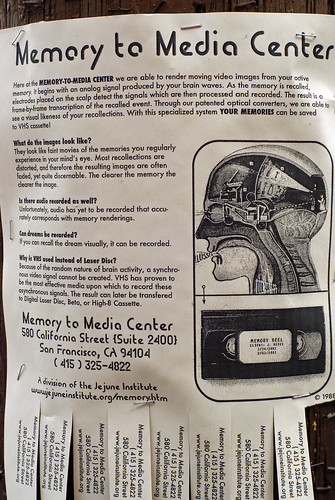
This final addition to today's meanderings may be of interest to people in the digital story telling couse. It seems we no longer need to interview and question to connect with family history. This company claims it can turn brain waves directly into videos.
 Click the image to see the full sized version. It has been reprinted from Judy Breck's Golden Swamp blog.
She has another blog called Learning Nodes which is dedicated to open learning. Her stuff is worth a look if you're in favour of connecting students to the global knowledge commons. She sees sees the way the brain is structured and functions as a metaphor for the interconnectedness (what she calls "intertwingularity") of the internet and the people who use it."On the left above is a screen shot of Science Standards from the Illinois State Board of Education (you can download the pdf from this page). On the right above is a drawing of a Synapse phosphoproteome network from the Genes to Cognition team at the Sanger Institute. The full size version of the image above is here.
I put the Illinois Learning Standards and the Synapse side-by-side to suggest that we require students to learn subjects inside of little boxes, while students think about them in highly connected networks. The boxes in the Standards are separated from each other in all sorts of ways: living things are in different boxes than processes of the Earth. Different things about the same subject are spread out over five different grade levels. There seems little chance of having a thought that relates an early box in “A” to a late box in “E.”
Yet the news for the future is very, very good! The beautiful Sanger Institute drawing of the synapse network looks an awfully lot like what subject knowledge does when we put in on to the open Internet. Students’ synapses would seem naturally to mesh with online learning because both are networks. Learners can – as the drawing suggests – start at most any point or level in a subject and follow what they are thinking and learning to connect it to any and all other points."
Meanwhile you can take this brain age calculation test. I didn't come off too badly, but then I wonder if there are actually different scores or if they give the same final result to everyone to give oldies like me a little boost.
And then give this test a try to see if you are more left or right brain dominant.
This final addition to today's meanderings may be of interest to people in the digital story telling couse. It seems we no longer need to interview and question to connect with family history. This company claims it can turn brain waves directly into videos.
Wednesday, October 27, 2010
Philippe Cousteau webinar, Thursday Oct.28
In case you haven't been reading the News section of your course moodle, Karena has arranged a Wilkes webinar with Philppe Cousteau for tomorrow at 4:00 p.m. EDT. EDIM alum & friends are also welcome to attend. The session will be archived and all those who register will receive the link.
Here's a lesson plan I did for the Globalization and Advocacy course which you are welcome to download. I used the Inquiry-Based Learning 5E's template furnished by Matt Cwalina and built a math lesson around the theme "Oil and Water Don't Mix" --
http://www.scribd.com/full/39526856?access_key=key-1ecvemo21p3cxopf37u1
Enjoy!
Topic: Spotlight on the Gulf Spill, How it Affects Us Now and in the Future. Questions, Answers and More Uncertainty
Date: Thursday, October 28
Time: 4:00 p.m. (EDT)
Registration: http://community.wilkes.edu/gradwebinar
*Pennsylvania educators will receive one hour of Act 48 credit if they provide their PPID at the time of registration
About this webinar: Join Philippe Cousteau, grandson of the legendary Jacques Cousteau and Discovery Education Chief Spokesperson for Environmental Education, as he takes you to the Gulf through pictures and stories from his recent trip to evaluate the effects of the Gulf Oil Spill. He will discuss the effects on regional wildlife and ecosystems as well as focus on how the oil spill will affect us now and into the future.
If you have any questions about this event, you can contact me at karena.zdeb@wilkes.edu or 800-945-5378 x7841
Hope you will join us!
For those who no longer can access the EDIM moodle, try this link and login with your name and a current email address: https://discoveryedevents.webex.com/discoveryedevents/onstage/g.php?t=a&d=666687010.
Here's a lesson plan I did for the Globalization and Advocacy course which you are welcome to download. I used the Inquiry-Based Learning 5E's template furnished by Matt Cwalina and built a math lesson around the theme "Oil and Water Don't Mix" --
http://www.scribd.com/full/39526856?access_key=key-1ecvemo21p3cxopf37u1
Enjoy!
Thursday, October 21, 2010
Attention Glogster Lovers ...
This notice recently landed in my inbox ---
 The student accounts are great because they don't require any personal information from the kids. You activate them from your dashboard. If you have not done this On the right side across from the messages, there will be a notice that says you have no student accounts. When prompted about how many you want, choose the maximum (100 until Nov. 7). I have no idea whether the new 50 rule will apply to old accounts that have not taken advantage of this feature or just the new ones, so I did mine today just in case. Now I just have to edit them to have individual icons and user names that make sense!
 The student accounts are great because they don't require any personal information from the kids. You activate them from your dashboard. If you have not done this On the right side across from the messages, there will be a notice that says you have no student accounts. When prompted about how many you want, choose the maximum (100 until Nov. 7). I have no idea whether the new 50 rule will apply to old accounts that have not taken advantage of this feature or just the new ones, so I did mine today just in case. Now I just have to edit them to have individual icons and user names that make sense!
Sunday, October 17, 2010
I shake therefore I am: The Mathematics of Metaphor
Prezi is a tool many try but few master. You need lots of patience and a strong visual sense of movement. If done well the story is told as much by the trail of connections as by the words and the images.
Here's a great one on metaphor! Explore it before you watch the video that inspired it which follows.
James Geary's TED talk ...
Here's a great one on metaphor! Explore it before you watch the video that inspired it which follows.
James Geary's TED talk ...
Friday, October 1, 2010
I connect therefore I am?
I came across this TED video of Sebastian Seung today. Seung thinks that our memories, our personality, our intellect --the 'stuff' that makes us who we are -- may be encoded in the connections between our neurons. He calls that our "connectome." As we grow and mature our personality changes slowly because our experiences change our connectome -- with new neurons and synapses growing and others dwindling and being lost. "The mere act of thinking can change our connectome."
It occurred to me as I watched Seung describe his "Quixotic" quest to map the human neural connectome, that personal learning networks and social networks could be an external manifestation of what he thinks is going on inside our brains. If "I am more than my genes," then humans are more than the individual subunits (i.e. people) that make up the world's population. (If you haven't guessed, I'm taking the Globalization and Advocacy course!)
If my metaphor works and the stuff of our humanity encoded in the relationships -- the connections -- that thread us all together into a collective, then every action -- however casual or seemingly isolated -- changes the connectome of the whole. This in turn reaffirms the power of the individual to change the pattern of relationships in the world, and then there is no individual action without a consequence for the network of relationships that make up the whole. ('Heady' stuff!!)
Seung aspires to map the connectome of the human brain with it's 100 billion neurons. It ought to be comparatively easy to map the connections between the mere 6.8+ billion individuals on our planet. I wonder what a connectome of the human race would look like.
It could be an interesting task to do one for family or a classroom first and then use the same kind of imagery as Seung did in his presentation (7:35-8:24) to show the scale of those interactions compared to the size of the macrocosm of the human family. The only thing I didn't like about Seung's images was that as he scaled up from the single neuron to the mouse brain and then the human brain, the original slice appeared to dwindle into insignificance and then disappear altogether. How could kids change the image to both preserve the sense of scale and at the same time represent the importance of one synapse or one person to the connectome of the whole?
Monday, September 13, 2010
CRSTE 2010 Cyberconference
There's a very cool online professional development event coming up in October from the 16th to the 24th.

"Featured presenters include: Dr. Karen Cator, Alan November, Mark Weston, CRSTE's Kathy Schrock Digital Pioneer and Leadership & Vision Award winners, and education leaders and ed tech leaders from across six continents! Each weeknight and weekend days and evenings, the Global Symposium will offer sessions that allow you to connect and collaborate with like-minded educators from around the world, seeking to work together to transform education for the Information Age."
From their wiki (which is open 24/7) you can register, take a look at some of the online tools people are using, test drive a tool and leave a comment or find someone to work with if the tool you're interested in is collaborative.
From the CRSTE website you can access the Elluminate archives of the Feb. 2010 event. Some of the more notable speakers were Ian Jukes, Kath Schrock, Sylvia Martinez, and Kim Caise, but there are over 100 sessions on topics ranging from " Laptops and 4th Grade Literacy" and "Animation and Digital Storytelling Across the Curriculum" to "Web-based Simulations that Build Math and Science Content Understanding" and "Putting the Horse Back Before the Cart: Technology Competencies All Educational Administrators Need".
If you're looking for a great way to spend some time with other educators from around the world, this looks like it will be a super event. See ya there, I hope!
Subscribe to:
Posts (Atom)


 Wilkes University

 Posts


